In this guide
If your bedroom still looks bright after lowering a blackout shade, look around its edges. Replacing the fabric or buying a different motor may leave the same light paths untouched.
This is the situation where we would put Norman Soluna with LightGuard 360 ahead of an ordinary roller shade with exposed perimeter gaps. Its appeal is the specified treatment around the fabric. That is the feature to compare in an order.
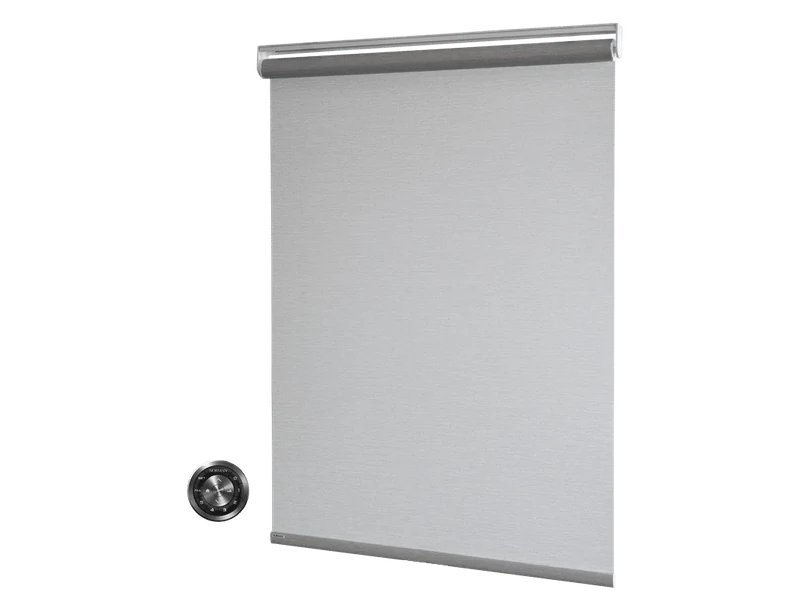
Our recommendation: shortlist Norman when you want the flat appearance of a roller shade and strong control of edge light. Soluna’s optional LightGuard 360 combines upper housing with side and bottom channels. Norman documents the components here.
The comparison: this is a design advantage over a fabric-only roller configuration. We have not measured Norman against every competing system with channels, and the evidence does not establish a universal blackout winner.
Blackout fabric and a dark room are different things
There are two routes to consider: light through the material, and light around it. Opaque fabric tackles the first. The window opening, brackets, fabric width and mounting arrangement determine the second.
This distinction applies across brands. Serena’s fabric guidance explicitly notes that blackout fabric can still leave light at the edges, depending on the shade style and installation. An expensive fabric or connected motor does not by itself close those gaps.
Fabric-only roller
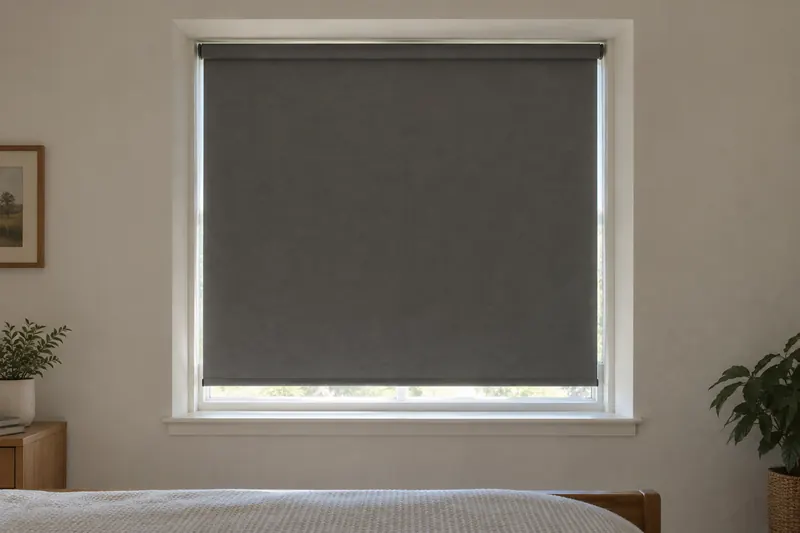
Blackout fabric addresses the center. Uncovered gaps can still admit light.
Fabric + perimeter treatment
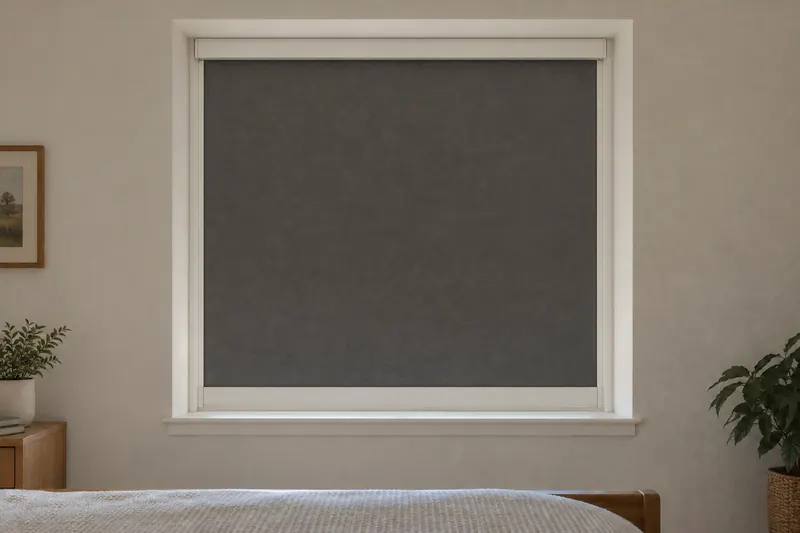
Housing, side channels and a bottom treatment address the perimeter too.
When comparing quotes, ask each seller to show what happens at the top, both sides and the bottom. A proposal that specifies those details gives you more useful information than the word “blackout” beside a fabric sample.
The specific advantage of Norman LightGuard 360
Soluna offers a named, optional configuration that brings the perimeter components together. The benefit for a buyer is practical: you can ask for LightGuard 360 and have the retailer specify the complete assembly for the window, instead of discovering untreated edges after installation.
Norman’s LightGuard 360 specification sheet (PDF) describes a custom-fitted aluminum system with inside- and outside-mount options. Have the retailer confirm which mount and lift configuration suit your opening.
For a bedroom where the visible problem is light around a conventional roller, this is a stronger starting specification. Our assessment is about addressing the problem’s physical cause. It is not a claim of a measured darkness percentage, better insulation or a quieter motor.
Specify the full name. Norman also lists a separate LightGuard option. Ask for LightGuard 360 and an itemized description of what is included; the names should not be treated as interchangeable.
How the competing configurations compare
Norman’s advantage becomes less decisive when the alternative also includes appropriate light-blocking hardware. These are the competing configurations worth comparing, rather than treating each brand’s simplest roller as its best blackout offering.
Swipe the table on a small screen to read every column.
| Configuration | What the documentation establishes | What to compare with Norman |
|---|---|---|
| Norman Soluna + LightGuard 360 | Upper housing, side channels and bottom channels supplied as a named system. Norman details. | The exact mount, fit, clearance and complete installed price. |
| Standard Serena roller with untreated gaps | Blackout fabric blocks light through the material; edge light depends on shade style and installation. Serena guidance. | Norman has a configuration advantage if the proposed roller leaves those gaps open. |
| Lutron roller + complete blackout hardware | Lutron documents side channels used with a sill angle and a suitable top treatment. System specification (PDF). | A credible full-system alternative. Confirm hardware compatibility with the actual Lutron product being quoted. |
| Graber roller + blackout channels | Graber lists channels along the sides and bottom of its roller shades. Graber options. | Ask how the top gap is handled. The available channels prevent a blanket claim that Norman is darker. |
| SmartWings roller + blockers or tracks | SmartWings offers inside-mount side light blockers and a separate side-rail system. | Compare the complete arrangement, including the top and bottom. Side blockers may be enough for an existing shade with only side leakage. |
| Hunter Douglas Duette + LightLock | LightLock uses U-shaped side channels with Duette cellular shades. Hunter Douglas details. | An alternative if you are open to cellular shades. It is a different shade construction, not a roller-to-roller comparison. |
For the wider comparison of motors, power, buying support and warranty terms, see our six-brand motorized roller-shade guide.
When we would choose Norman first
Norman is a particularly sensible first quote when these conditions line up:
- You want a roller shade. You prefer a flat fabric panel to pleated cellular fabric or additional drapery.
- Edge light is the main problem. The fabric itself is opaque enough, but daylight remains visible around the opening.
- You are ordering a complete custom installation. The retailer can address the shade, perimeter treatment and fit together.
- You accept the additional visible hardware. Channels and housing are part of the appearance you are choosing.
An example: you are replacing an inside-mounted roller in a bedroom, and bright side strips plus a top gap remain when it is closed. A LightGuard 360 quote directly addresses those points. A quote for another opaque roller without edge treatment leaves the important part of the decision unresolved.
When another solution may suit you better
Your current shade only leaks at the sides. Ask whether compatible side blockers can solve that specific problem before replacing a working shade. SmartWings’ documented accessories illustrate this route; check fit and attachment on your own setup.
You already have a fully specified Lutron or Graber solution. Compare it on the window, with all required channels and top treatment included. The documentation alone does not justify paying more for Norman on the assumption that it must be darker.
You are happy with cellular shades. Include Duette with LightLock in the discussion. Preferring a roller’s appearance is a valid reason to favor Soluna; it does not prove superior darkness.
You want an exposed roller with minimal surrounding hardware. A perimeter system changes that look. Decide whether reducing edge light is worth the added frame-like treatment before ordering.
Motorization is a separate decision
The light-control hardware is the reason for the recommendation here. The motor determines how the shade moves and how you control it.
Norman’s motorization reference guide (PDF, printed pages 24–26) lists LightGuard 360 configurations with rechargeable and wired power choices. Some charging arrangements have clearance requirements. Have the retailer confirm the selected motor, power connection and access for your measured window.
For a high-mounted bedroom window, ask someone to demonstrate the actual charging process. For a connected system, include the required remote and hub in the quote and confirm compatibility with the platform you use. Our Norman motorization overview covers the named system and control requirements.
What to ask before placing an order
Use the same checklist for Norman and each alternative:
- Identify all four edges. Have the installer mark the top, sides and bottom treatment on the drawing. Ask whether any gaps remain at joins or corners.
- Check the real opening. Window handles, trim, uneven surfaces and recess depth can affect how the assembly fits and operates.
- See a daylight demonstration. Ask for a sample installation or mockup. View it under light conditions relevant to your room; photographs taken with different camera exposure are a poor comparison.
- Check daily use. See the shade travel, confirm the stopping position and find out how charging and service will work.
- Get the full price and remedy in writing. Include fabric, channels, housing, motor, controls, measuring and fitting. Ask who pays to correct a measurement or installation problem.
This emphasis on fit is consistent with Lutron’s technical guidance on maximizing light blockage, which discusses gaps, overlap, obstructions and site mockups. It is a useful principle whichever brand you select.
Our buying recommendation
For bedroom blackout, put Norman Soluna with LightGuard 360 ahead of a standard roller proposal that does not treat the perimeter. It offers a clearly specified route to solving edge-light problems while retaining roller-shade construction.
Against another complete channel-equipped system, compare the installed result, appearance, controls, support and total quote. That is the point where a window-specific demonstration matters more than a brand label.
Research scope: manufacturer product pages and technical documents were checked September 8, 2026 and are linked beside the relevant claims. Recommendations reflect documented construction and our editorial assessment. We have not performed a controlled head-to-head light measurement. See our research methodology.
Frequently asked questions
Does Norman LightGuard 360 outperform every competing blackout shade?
That has not been established by the evidence reviewed here. The supported advantage is its complete perimeter treatment compared with a standard roller that leaves edge gaps exposed. Competitors also offer channels and complete blackout configurations, which deserve a direct comparison.
Is LightGuard 360 the same as blackout fabric?
No. It is an optional surrounding system used with the shade. Fabric addresses light through the material; the additional housing and channels address light around it. Ask for the exact LightGuard 360 configuration in the quote.
Will it guarantee a completely dark room?
No guarantee follows from the product description. Window fit, installation, joins and other light sources in the room affect the outcome. Norman’s own blackout guidance acknowledges that complete daytime light exclusion is not assured.
Can Soluna with LightGuard 360 be motorized?
Motorized configurations are documented. Have a Norman retailer confirm the motor, power option, charging access and controls for the exact window and mounting arrangement.