In this guide
Motorised shades are the smart home upgrade people are most surprised by. Lighting and security are useful in a practical, slightly abstract way. Shades that lift with the sunrise change how a room feels every single morning, which is a different kind of benefit entirely.
They are also the category with the widest price range and the least transparent pricing. A retrofit motor costs less than a video doorbell; a made-to-measure shade for the same window can cost more than a whole security system. This guide explains what separates those numbers.
What motorised blinds actually are
A motorised blind is a conventional window covering with a small motor driving the mechanism, controlled by a remote, an app, a schedule or a voice assistant.
That is genuinely all. The complexity comes from the choices around it: what kind of covering, how the motor is powered, what radio it uses to receive commands, and whether it is retrofitted to something you own or built to measure.
The pull cord disappearing is worth a moment. Corded blinds remain a recognised strangulation hazard for young children, and safety regulations in several markets have pushed the industry toward cordless designs. Motorisation removes the cord entirely, which for households with small children or pets is a genuine safety improvement rather than a convenience.
The four benefits, honestly weighted
Convenience, and specifically for windows you never touch. The real benefit is not saving effort on windows you already adjust — it is that windows behind furniture, above stairwells or high in double-height rooms suddenly become usable. Most homes have two or three windows that are effectively fixed in one position because reaching them is annoying.
Energy performance, which is real but modest. Windows are the weakest thermal element in most walls. Shades closing automatically during summer afternoon sun reduce solar gain; cellular shades closing on winter nights add insulation. Published figures on savings vary enormously and depend heavily on your glazing, orientation and climate — treat specific percentages from vendors sceptically. The effect is genuine; it is not usually transformative.
Security through occupancy signalling. Blinds that move on a varied schedule make an empty house look occupied — and unlike lighting, they signal occupancy during daylight too. Blinds that have not moved in a week are a reasonably strong signal that nobody is home. This pairs well with the deterrence findings in our statistics guide.
Sleep and routine. The one people underrate. Blackout shades that lift gradually at a set time wake you with increasing light rather than an alarm. Several households we have spoken to describe this as the single best thing in their smart home, which is not what anyone expects going in.
Types of motorised covering
The mechanism determines both the look and what motorisation costs.
| Type | How it works | Best for | Relative cost |
|---|---|---|---|
| Roller shades | Fabric rolls onto a tube containing the motor | Most windows — the default choice | Low to medium |
| Cellular / honeycomb | Pleated cells trap air; raises and lowers | Best insulation; cold rooms | Medium |
| Venetian / horizontal | Slats tilt and the stack raises | Light control without full blackout | Medium |
| Vertical blinds | Slats rotate and draw sideways | Patio doors, very wide openings | Medium |
| Roman shades | Fabric folds into soft horizontal pleats | Formal or design-led rooms | High |
| Curtains / drapery track | Motor draws fabric along a track | Existing curtains, large windows | Medium to high |
| Exterior shades | Mounted outside the glass | Best solar heat rejection | High |
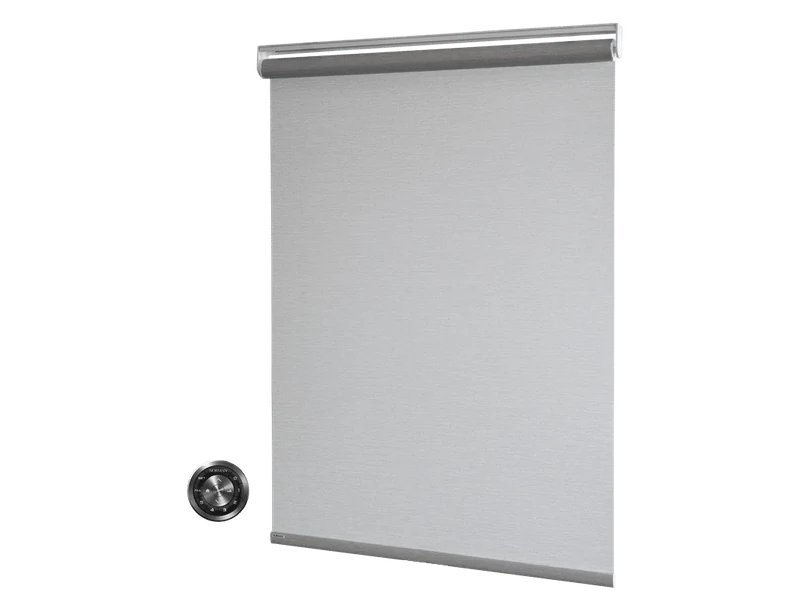
Roller shades deserve their popularity: the tube gives the motor a natural home, the mechanism is simple, and fabric choice covers everything from sheer to full blackout. If you have no specific reason to choose otherwise, start here. Our six-brand motorized roller shade comparison covers Lutron, Hunter Douglas, Norman, Graber, SmartWings and Graywind.
Cellular shades are the choice where thermal performance matters. The trapped air in the cells provides genuine insulation, which makes them the sensible pick for a room that is always cold — or for large north-facing glazing.
Exterior shades are far more effective at rejecting solar heat than anything internal, because they stop the energy before it passes the glass. They are expensive, need weather-rated hardware, and are worth considering for large south or west-facing glazing in hot climates.
Power: the decision that shapes everything else
How the motor is powered determines installation difficulty, ongoing maintenance and a large share of the cost.
| Power option | Installation | Maintenance | Best for |
|---|---|---|---|
| Rechargeable battery | None — just mount it | Recharge every 6–12 months | Retrofits, renters, single rooms |
| Battery + solar strip | None | Effectively none | Most retrofits — the sweet spot |
| Low-voltage wired | Cable to each window | None | New build or renovation |
| Mains hardwired | Electrician required | None | Large, heavy or exterior shades |
Battery is what makes retrofit possible. Modern rechargeable motors last six to twelve months on a charge depending on how often they run, and recharging means unclipping the motor or plugging in a cable for a few hours.
Solar strips are the upgrade we recommend most often. For roughly $30–$60 per window, a small panel on the glass keeps the battery topped up indefinitely on any window with reasonable daylight. It converts a recurring chore into a fit-and-forget installation, and it pays for itself in avoided annoyance within a year.
Wired is unambiguously better if you are already opening walls. During a renovation, running low-voltage cable to window heads costs very little extra and removes the power question permanently. Retrofitting that cable into finished walls is a different and much more expensive proposition.
Protocols: how the blind receives commands
This determines reliability, and it is the specification most buyers ignore and later regret.
Bluetooth is cheapest and works phone-to-blind at short range. Without a bridge there is no remote control, no scheduling when you are out, and no voice assistant. Adequate for a single blind, frustrating for a house.
Wi-Fi connects directly to your router — no hub, straightforward setup. The drawback is that each blind consumes an IP address and competes for airtime on the crowded 2.4 GHz band. With four or five blinds this is fine; with fifteen, alongside cameras and everything else, congestion becomes a real problem.
Zigbee and Z-Wave use low-power mesh networks with a hub. Each mains-powered device relays for others, so reliability improves as the system grows. Z-Wave’s sub-GHz frequency penetrates walls better than anything on 2.4 GHz.
Thread and Matter is where new equipment is heading — mesh networking with cross-ecosystem compatibility. See our explainer for what it does and does not deliver.
Proprietary radio — principally Lutron’s Clear Connect — runs on a quiet frequency the manufacturer controls entirely. This is why installers specify Lutron: it responds instantly and keeps doing so in environments where Wi-Fi devices struggle. The cost is being locked into one manufacturer.
Motor noise: the specification nobody quotes
No showroom mentions this and it is the difference you will notice most.
Motor quality varies enormously and correlates closely with price. A budget motor is audibly mechanical — a distinct grinding whirr. A premium motor is a soft, low hum that fades into the background.
In a living room during the day, this is irrelevant. In a bedroom on a 6:45 a.m. schedule, it is the entire experience: a quiet motor lifting the blind with the light is pleasant, and a noisy one wakes you with a mechanical noise, which rather defeats the purpose.
Practical advice: if you can only afford premium motors on some windows, put them in bedrooms and accept budget motors elsewhere. And if you visit a showroom, ask them to run the shade while you stand next to it — the difference is obvious in person and invisible on a spec sheet.
What it costs
| Route | Per window | Installation | Suits |
|---|---|---|---|
| Retrofit motor Motorises blinds you already own | $70–$120 | DIY, 15 min | Renters, trying it, existing good blinds |
| Ready-made motorised Standard sizes | $130–$250 | DIY, 30 min | Standard windows, whole rooms on a budget |
| Made-to-measure Custom size and fabric | $300–$1,000+ | $100–$250 | Odd sizes, design-led rooms |
| High-end integrated Lutron Sivoia and similar | $800–$2,500+ | Included | Whole-house projects |
Our cost guide breaks this down further, including whole-house budgets. The short version: start with one or two retrofit motors before committing to a house. They cost little, install in fifteen minutes, and tell you quickly whether motorisation is something you will actually use.
Measuring: where expensive mistakes happen
Made-to-measure shades cannot be returned for a measuring error. This section is the most valuable part of this page.
Inside mount (shade sits within the recess):
- Measure width at the top, middle and bottom of the recess. Use the smallest. Recesses are almost never square.
- Measure height at left, centre and right. Use the largest.
- Check the depth. Motorised rollers need more recess depth than manual ones because of the motor inside the tube. Confirm the minimum depth for your chosen product before anything else — this is the single most common cause of an unusable order.
Outside mount (shade sits on the wall over the recess):
- Add at least 3 inches either side of the opening to control light gap.
- Decide the mounting height first, then measure from there to the sill.
- Check for obstructions — handles, trim, radiators, curtain poles.
Measure in millimetres or to the nearest ⅛ inch, write it down immediately, and measure every window separately even where they look identical. They are not.
Installation: what is DIY and what is not
Genuinely DIY: retrofit motors on existing blinds (about fifteen minutes, no tools beyond a screwdriver); ready-made motorised blinds in standard sizes; battery and solar-powered shades of ordinary size.
Worth paying for: made-to-measure shades, where a fitting error is expensive; anything requiring mains or low-voltage wiring; very wide or heavy shades, where brackets must be fixed into structure rather than plasterboard; exterior shades; and whole-house installations where commissioning matters.
Two practical notes for DIY fitting. Find the structure. Brackets fixed only into plasterboard will pull out under the repeated torque of a motor — heavier than a manual blind, and cycled twice a day. Use the timber lintel or proper cavity fixings. And check level twice: a shade fitted slightly out of level will track sideways as it rolls, and after a few weeks it will bunch at one end.
Automation worth setting up
Once installed, the schedules people actually keep are simpler than the ones they first configure.
Sunrise wake. Bedroom shades lifting gradually from about twenty minutes before your alarm. The most valuable automation in this category by a wide margin.
Solar management. South and west-facing shades lowering during peak afternoon sun in summer, raising in winter to allow passive heating. Tie it to sun position rather than clock time so it tracks the seasons.
Privacy at dusk. Ground-floor shades lowering at sunset. Simple, and the one people miss most when it stops working.
Occupancy simulation. Varied timing while away, so the pattern does not look mechanical. Blinds that have not moved in a week signal an empty house.
What to skip: elaborate multi-condition rules involving weather APIs and room occupancy. They break, they are hard to debug, and the marginal benefit over a good sun-position schedule is small.
Maintenance and common faults
Motorised blinds need very little, but three faults account for most problems.
The shade drifts out of alignment. Fabric tracks sideways over weeks and bunches at one end. Almost always a bracket that is not level. Re-level and re-set the limits.
Battery life collapses. Usually the shade cycling far more often than intended — a schedule firing repeatedly, or an automation looping. Check the activity log before assuming the battery has failed.
The blind stops responding intermittently. Nearly always radio congestion rather than a fault, particularly with Wi-Fi blinds in a busy 2.4 GHz environment. This is why the four-window rule above matters.
Routine care is minimal: dust the fabric occasionally, keep the solar strip clean if fitted, and re-set the upper and lower limits if the shade starts over- or under-travelling.
Where to start
If you are convinced but unsure how to begin:
- Buy one retrofit motor for a bedroom blind you already own. Roughly $70–$120, fifteen minutes, fully reversible.
- Set up a sunrise schedule and live with it for a month. This tells you more than any amount of research.
- If you like it, extend to the other bedrooms and to windows that are awkward to reach — the two categories with the highest payoff.
- Only then consider made-to-measure shades for rooms where appearance matters, and get someone to measure.
Our best smart blinds guide covers specific products, and the cost guide has whole-house budgets. If you are considering a larger project, a free consultation with a local installer costs nothing and will tell you quickly what your windows actually need.
Frequently asked questions
How much do motorised blinds cost?
Roughly $70–$120 for a retrofit motor on blinds you already own, $130–$250 for ready-made motorised blinds, and $300–$1,000+ per window for made-to-measure, plus $100–$250 fitting.
Can I motorise blinds I already have?
Often yes. Retrofit motors clip onto existing mechanisms for $70–$120 per window and are fully reversible, which makes them the only genuinely renter-friendly option.
Do motorised blinds need wiring?
Not necessarily. Rechargeable battery models need none, and a solar strip removes recharging entirely. Wired options suit new builds and heavy or exterior shades.
How long do the batteries last?
Typically six to twelve months depending on how often the shade cycles. A solar strip on a window with reasonable daylight effectively removes recharging altogether.
Are motorised blinds noisy?
It varies enormously and correlates with price. Budget motors are audibly mechanical; premium motors are a soft hum. It matters most in bedrooms on a morning schedule — ask to hear one running before buying.
Do motorised blinds save energy?
They help by reducing summer solar gain and adding night-time insulation, particularly cellular shades. The effect is real but modest, and depends heavily on your glazing, orientation and climate. Treat specific vendor percentages sceptically.
Can motorised blinds work with Alexa, Google or Apple Home?
Most do, though it depends on the protocol. Bluetooth-only blinds usually need a bridge. Matter-compatible blinds work across all three ecosystems.
What recess depth do motorised roller shades need?
More than manual rollers, because the motor sits inside the tube. Requirements vary by product — confirm the minimum depth before measuring anything else, as this is the most common cause of an unusable order.