In this guide
For a decade the smart home has been a mess of incompatible ecosystems. Matter was announced as the fix, backed by Apple, Google, Amazon and Samsung together — an unusual alliance that made people hopeful.
Several years on, the picture is more nuanced than either the hype or the backlash suggests. Here is what these standards actually do.
The one-sentence version
Thread is a network. It is how devices physically talk to each other — a low-power mesh radio, comparable to Wi-Fi or Zigbee in role.
Matter is a language. It is what devices say once connected — a common vocabulary so a lock from one company can be understood by an app from another.
They are frequently mentioned together because they work well together, but they are independent. A Matter device can run over Wi-Fi or Ethernet instead of Thread. A Thread device does not have to speak Matter.
What Thread actually improves
Thread is a genuine technical improvement over what came before, for three reasons.
It is a mesh. Every mains-powered Thread device relays for its neighbours. Add a Thread smart plug and every battery sensor near it gets a better path home. Coverage improves as you add devices, rather than degrading.
It is low power. A Thread sensor runs for years on a coin cell. A Wi-Fi sensor doing the same job needs recharging or mains power.
It has no single point of failure. Zigbee and Z-Wave route through one coordinator; if it dies, the network dies. Thread has multiple border routers and self-heals around a failure.
If you have ever had a smart home where devices at the edge of the house drop off unpredictably, Thread addresses precisely that.
What Matter promised, and what it delivered
The promise was: buy any Matter device, use it with any Matter platform, no bridges, no hubs, no compatibility charts.
What genuinely works: basic control across ecosystems. A Matter bulb pairs with Apple Home, Google Home and Alexa simultaneously and turns on and off from all of them. Setup is markedly simpler than it was. Local control means devices respond without a round trip to a distant server, so they work during an internet outage.
What does not work as advertised: anything beyond the basics. Matter defines a common set of capabilities, and manufacturers implement features beyond that in their own apps. So a robot vacuum appears in Apple Home as something you can start and stop, while zone cleaning, mapping and scheduling remain in the manufacturer’s app. The same pattern holds across cameras, locks and thermostats.
The honest summary: Matter solved the easy 80% of interoperability. The remaining 20% — the features you actually chose the device for — is still fragmented, and there is no sign of that changing soon.
Should you wait before buying?
No. This is the practical question, and the answer is straightforward.
Waiting for a standard to mature is how people spend three years not having a smart home. Matter has been shipping for several years and is still incomplete; it will still be incomplete next year.
Two sensible rules instead:
- Prefer Matter and Thread support where the price is similar. It costs nothing and improves your options later.
- Do not pay a meaningful premium for it, and do not reject an otherwise better device because it lacks it. A device that does its job well within one ecosystem beats a device that is universally compatible and mediocre.
The exception is if you have deliberately mixed ecosystems — an Apple household with a Google speaker, say. There, Matter support genuinely matters.
What you need to use Thread
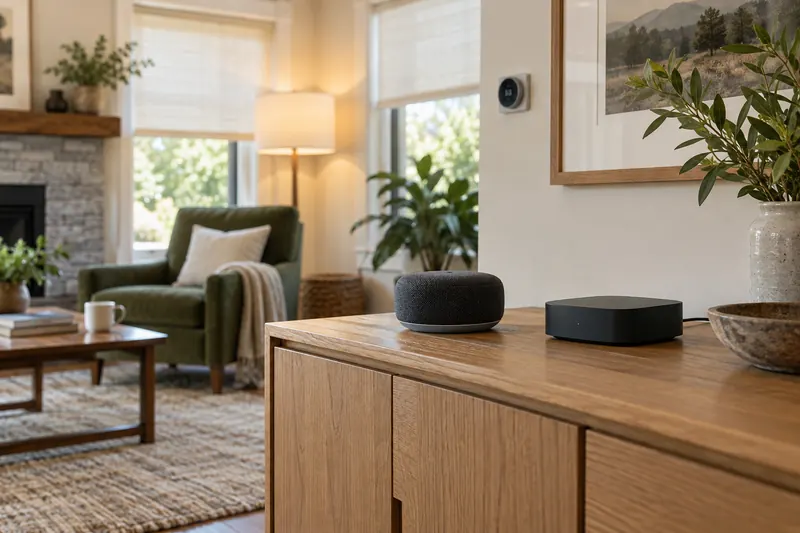
Thread requires a border router — a mains-powered device that connects the Thread mesh to your home network. You probably already own one.
| Ecosystem | Common border routers |
|---|---|
| Apple | HomePod mini, HomePod, Apple TV 4K (newer models) |
| Nest Hub (2nd gen), Nest Hub Max, Nest Wifi Pro | |
| Amazon | Echo (4th gen and later), Echo Hub |
| Samsung | SmartThings Hub, some newer TVs and appliances |
Two or three border routers spread around the house gives better coverage than one, and there is no downside to having several.
Where this leaves Zigbee and Z-Wave
Not dead, and not urgent to replace.
Z-Wave runs on a sub-GHz frequency that avoids the congested 2.4 GHz band, giving it better range through walls than Thread. It remains excellent for sensors in large or solidly built houses, and the certification programme means interoperability is genuinely reliable.
Zigbee has an enormous installed base and very cheap devices. Philips Hue still runs on it.
Practical advice: do not rip out working Zigbee or Z-Wave. Hubs like Abode and SmartThings bridge them into Matter, so old devices appear alongside new ones. Buy Thread and Matter for new purchases; leave the working ones alone.
Frequently asked questions
What is the difference between Matter and Thread?
Thread is a network — how devices physically connect. Matter is a language — what they say once connected. Matter can run over Wi-Fi or Ethernet as well as Thread.
Do I need a hub for Matter?
For Thread devices, yes — a border router, which most people already own in the form of a HomePod mini, Nest Hub or newer Echo. Matter-over-Wi-Fi devices need no additional hardware.
Should I wait for Matter to mature before buying?
No. It has been shipping for years and remains incomplete. Prefer Matter support where prices are similar, but do not pay a premium or reject a better device for lacking it.
Does Matter work with everything?
For basic control, largely yes. Advanced features stay in the manufacturer’s app — a Matter vacuum starts and stops from any platform, but zone cleaning still requires its own app.
Is Z-Wave obsolete now?
No. Z-Wave’s sub-GHz frequency gives better wall penetration than Thread, and it remains excellent for sensors in large homes. Do not replace working devices.