In this guide
The home security market is deliberately confusing. Pricing is quote-based, packages are non-comparable, and every brand claims to be best for everyone. The way out is to decide what you need before you look at what anyone sells.
Work through these six questions in order. By the end you will have eliminated most of the market, and the remaining choice is usually between two systems.
Question 1: What are you actually protecting against?
This sounds abstract. It is the most useful question on the page, because different threats call for different systems.
Opportunistic burglary — the overwhelming majority of residential break-ins. Someone tries a door, looks for an easy window, and leaves if the property looks difficult. Deterrence works: visible cameras, signage, lighting, an audible siren. Almost any competent system addresses this.
Package theft. A video doorbell is the answer, and a full alarm is largely irrelevant.
Knowing what happens while you are away — deliveries, contractors, a teenager arriving home, an elderly parent. This is a camera and notification problem, not an alarm problem. Self-monitoring is usually sufficient.
Fire, flood and carbon monoxide. Frequently overlooked and statistically far more likely to cause serious loss than burglary. Monitored smoke and CO detection is one of the strongest arguments for professional monitoring, and it is rarely the reason people buy.
Question 2: Do you own or rent?
This eliminates more options than anything else.
If you rent: you need adhesive sensors and no drilling; a retrofit lock rather than a replacement deadbolt; a system that comes with you; and no multi-year contract, because your address may not last that long. That points firmly at SimpliSafe, Ring or Abode, and away from ADT’s professionally installed systems and Vivint entirely.
If you own: everything remains open. Wired cameras, professional installation and long contracts all become viable — though none becomes automatically sensible.
Question 3: Will you accept a contract?
Answer honestly, because this is where most regret originates.
A 36-month contract is a reasonable arrangement if you own your home, plan to stay, and value having one company responsible. It is a bad arrangement if there is any real chance you will want out — and life across three years is less predictable than it feels when signing.
The useful test: if you had to cancel in month 14, how much would that cost, and would you resent it? Ask for the early-termination formula in writing. A straight answer is a good sign about who you are dealing with.
If the answer is no contract, that removes ADT’s professionally installed systems and most Vivint financing arrangements. What remains — SimpliSafe, Ring, Abode, Cove — covers most households perfectly well.
Question 4: DIY or professional installation?
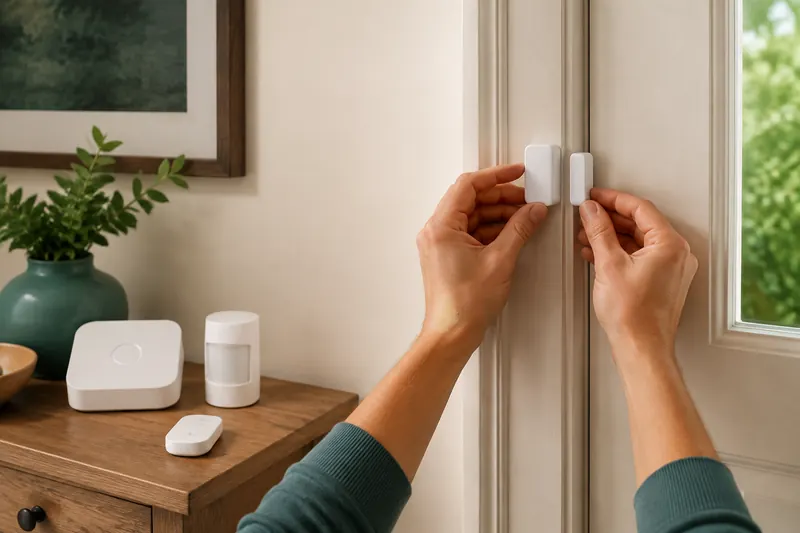
DIY installation is genuinely easy for most homes. Adhesive sensors, no tools, about an hour. The real work is deciding where sensors go, and you are better placed to judge that than a technician working through a checklist.
Professional installation is worth paying for when:
- You want hardwired cameras — running cable through finished walls is real work.
- The property is larger than roughly 2,500 sq ft, where wireless range needs planning.
- You are retrofitting into existing alarm wiring or a structured cabling system.
- Anything involves mains electricity — powered cameras, hardwired sirens, lighting circuits.
- You simply do not want to. This is a legitimate reason and does not need justifying.
If any of those apply, a free consultation costs nothing and will tell you quickly whether the job is worth paying for.
Question 5: Professional monitoring, or self-monitoring?
Widely misunderstood, so here is what actually happens.
With professional monitoring, an alarm goes to a central station. An operator calls you and asks for a passcode. If you cannot be reached, or confirm an emergency, they dispatch police.
With self-monitoring, you get a notification and decide what to do.
| Your situation | Recommendation |
|---|---|
| Flat with neighbours close by | Self-monitoring is usually adequate |
| You travel regularly | Professional monitoring |
| You sleep heavily or work night shifts | Professional monitoring |
| You want monitored smoke and CO detection | Professional monitoring |
| You want an insurance discount | Professional monitoring (check requirements) |
| Budget is the binding constraint | Self-monitor now, add later if needed |
Note that response time depends mostly on your local police, not the monitoring company. And many jurisdictions deprioritise unverified alarms because false-alarm rates are so high — which is why verification features like SimpliSafe’s agent intervention matter more than they appear to.
Question 6: What is your realistic budget?
Not the sticker price — the total across the years you will own it.
| Budget over 3 years | What it buys | Look at |
|---|---|---|
| Under $400 | DIY kit, self-monitored, no subscription | SimpliSafe unmonitored, Eufy cameras, Wyze |
| $900–$1,700 | DIY kit with professional monitoring; depends on plan | SimpliSafe Standard/Core, Ring, Cove, Abode |
| $2,000–$3,200 | Professionally installed and monitored | ADT |
| $3,500–$5,500 (5yr) | Fully integrated, professionally designed | Vivint |
Be sceptical of the reflex that more expensive means safer. The gap in monitoring quality between a $20/month DIY plan and a $60/month professional one is much smaller than the price difference suggests. What the extra money buys is installation, service and integration — valuable to some households, irrelevant to others.
Putting it together
Three common conclusions, drawn from the answers above.
“I rent, want no contract, cameras are secondary.” Consider SimpliSafe Standard at $22.99/month for professional dispatch without recording. Core is $32.99/month if you want recording with monitoring. Add the equipment cost and compare the full plan options before buying.
“I want cameras and an alarm, and the lowest total cost.” Buy Ring with the top plan. Unlimited cameras plus monitoring for about $20 a month.
“I own a larger home and want it designed, installed and integrated.” Get quotes from Vivint and ADT — and get the full multi-year total in writing from both before signing anything.
Our full ranking covers each in depth.
Frequently asked questions
What should I look for in a home security system?
In order: whether it suits owning or renting, contract terms, installation method, monitoring type, and total cost over three years. Brand should be the last consideration, not the first.
Is professional monitoring worth it?
It earns its cost if you travel, sleep heavily, are often unreachable, or want monitored smoke and CO detection. For a flat with neighbours nearby, self-monitoring is frequently adequate.
How much should I spend on home security?
Most households are well served by $700–$1,200 over three years — a DIY kit with professional monitoring. Spending more buys installation and integration rather than better monitoring.
Do security systems reduce home insurance?
Often, typically 5–20%, but requirements vary. Most insurers require professional monitoring rather than professional installation. Ask what documentation yours accepts before buying.
Should I buy or lease security equipment?
Buy, if you can. Leased equipment ties you to a provider and has no resale value. Owning your equipment keeps you free to change monitoring companies.