In this guide
You have seen the figures on every security company’s website: homes without security are three times more likely to be burgled, most burglaries happen during the day, burglars avoid homes with cameras.
Some of that is well supported. Some traces back to a single small study from decades ago and has been repeated until it sounds like established fact. This page separates the two, and is careful about what it claims.
A note on why this is hard
Residential burglary data has real methodological problems, and any honest page about it has to say so first.
Under-reporting. A substantial share of burglaries are never reported, particularly where nothing of value was taken or there is no insurance claim to support.
Self-selection. Homes with security systems differ from homes without them in income, location and tenure. When a study finds security systems reduce burglary, some of that difference is the neighbourhood, not the alarm.
Offender interview studies — the source of most “burglars say” claims — use small samples of convicted burglars, who are by definition the ones who got caught.
Vendor-funded research. A meaningful share of widely-cited figures originate with companies selling security products.
What is reasonably well supported
Burglary rates have fallen substantially over decades. This is one of the most robust findings in criminology across many developed countries. Explanations vary — better locks and building standards, changes in the value and traceability of portable goods, wider social factors — but the trend itself is not disputed.
Most residential burglary is opportunistic rather than planned. Offenders generally look for accessible, unoccupied, low-risk targets rather than selecting a specific house in advance. This is why visible deterrence works at all.
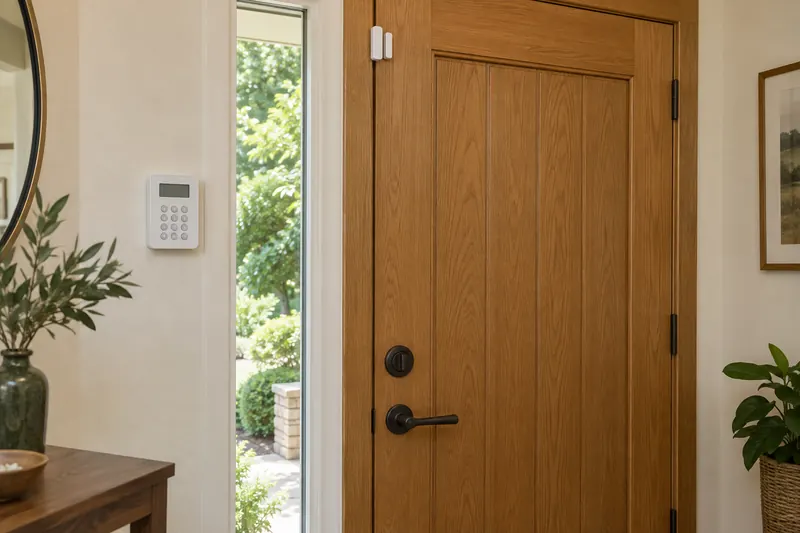
Entry is usually through a door. Doors — front, back and side — account for the majority of entries, with ground-floor windows the main remainder. This is well enough established to act on: it is why sensor placement should start with doors.
Concealment matters. Entry points hidden from the street are favoured. Back and side doors behind fences or hedges are disproportionately used, which is a practical argument for putting your first camera at the back rather than the front.
Visible security measures deter. Offender interview studies consistently report that alarms, cameras and signs of occupancy discourage target selection. The size of the effect is uncertain; the direction is not.
What is weaker than it is presented
“Homes without security are 300% more likely to be burgled.” This figure circulates without consistent sourcing, and where it can be traced it usually rests on studies that do not adequately control for neighbourhood and income. Security systems very likely reduce risk. That specific multiplier should not be treated as established.
“A burglary happens every X seconds.” Arithmetically derived from national annual totals. Technically true, rhetorically misleading — it tells you nothing about risk to any individual household, which varies enormously by area.
“Most burglaries happen between 10am and 3pm.” Daytime burglary is common, because homes are empty. But the frequently quoted precise window traces to older, narrow datasets. The useful takeaway is simply that an empty house is the risk factor, not a particular hour.
“Burglars spend an average of X minutes inside.” Derived from small offender-interview samples. Directionally sensible — they leave quickly — but the precise figures are not solid.
What the evidence suggests you actually do
Setting aside contested numbers, the well-supported findings point to a short and unglamorous list.
- Secure doors first. Most entries are through doors. A solid deadbolt with a reinforced strike plate and long screws into the frame stud does more than most electronics — the common failure is a frame splitting, not a lock breaking.
- Cover the concealed entry point. If you buy one camera, put it at the back or side door, not the front.
- Make the house look occupied. Randomised lighting, no parcels accumulating on the step, no bins left out for a week. This is where smart lighting genuinely earns its place.
- Be visible about it. Signs and visible cameras affect target selection. This is one of the few places where the cheap option and the effective option coincide.
- Do not neglect fire and CO. Statistically far more likely to cause serious loss than burglary, and consistently under-prioritised.
Putting risk in perspective
A point rarely made by companies selling security systems: for most households in most areas, the annual probability of burglary is low, and it has been falling for decades.
That is not an argument against security. It is an argument for proportionality. A $250 DIY kit and a well-fitted deadbolt address the realistic threat for most homes. A $5,000 five-year commitment is a different kind of decision, and worth making deliberately rather than under pressure from a doorstep salesperson invoking recent local break-ins.
Our decision guide works through what is proportionate for your situation.
Frequently asked questions
Do home security systems actually prevent burglary?
The evidence that visible security measures affect target selection is reasonably consistent across offender interview studies. The precise size of the effect is uncertain, and widely-quoted figures like "300% more likely" are not well sourced.
Where do most burglars enter?
Through doors — front, back and side — with ground-floor windows the main remainder. Entry points concealed from the street are favoured, which is why your first camera belongs at the back.
Do most burglaries happen during the day?
Daytime burglary is common because homes are empty. The frequently quoted precise time window comes from older narrow datasets; the useful point is that an empty house is the risk factor.
Are security statistics from companies reliable?
Treat precise figures without a named source and year as marketing. A meaningful share of widely-cited statistics originate with companies selling security products.